
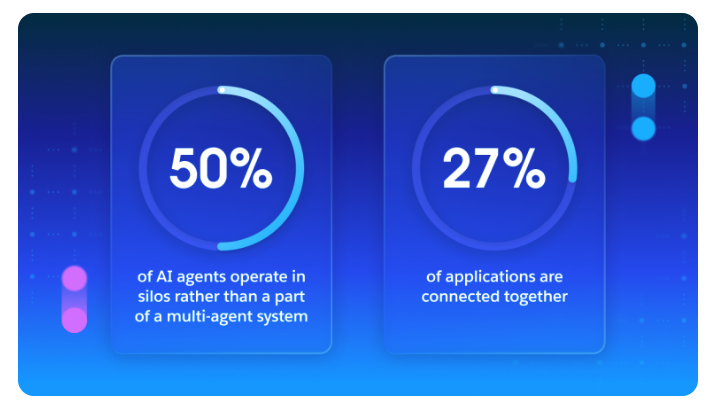
Nine hundred and fifty seven. That is the average number of software applications running inside a large enterprise today, according to Salesforce’s 2026 Connectivity Benchmark Report. Only about 27 percent of them are actually integrated with anything else. The other 73 percent sit there, each one a little island, each one somebody’s good idea from three budget cycles ago.
You do not need a Fortune 500 IT department to feel that number in your gut. If you operate multifamily, self storage, or any real estate portfolio of scale, you are probably running somewhere between twenty and thirty point solutions right now: a PMS as your system of record, a separate CRM for leasing, a payments processor bolted onto the side, a general ledger that reconciles to the PMS about as cleanly as two siblings agree on how to split an inheritance, plus a rotating cast of tools for maintenance tickets, insurance, package lockers, screening, and whatever your last regional VP saw at a conference. Nobody designed this stack on a whiteboard. It accreted, one point solution at a time, each one solving a real problem in isolation and creating a new one in aggregate.
This is the year everyone rediscovers the build vs buy question, because AI coding tools have made it genuinely cheap to spin up a working piece of software in an afternoon. The pitch to a CIO or a portfolio operations lead practically writes itself: why keep paying a vendor a subscription for something a product manager and an AI agent could build in a sprint? For an industry that has spent a decade watching its software budget balloon with tools it only half uses, that pitch lands. It should land. It is also, for the parts of your stack that actually matter, almost entirely beside the point.
In short:
- The average enterprise runs about 957 software applications; only 27 percent are integrated (Salesforce, 2026).
- Real estate operators typically run 20 to 30 point solutions across leasing, accounting, payments, and maintenance.
- AI coding tools cut the cost of writing software. They do not cut the cost of operating, securing, and maintaining it for years afterward.
- Large IT build projects run 45 percent over budget and deliver 56 percent less value than planned, with 17 percent severe enough to threaten the business (McKinsey and Oxford).
- Gartner predicts more than 40 percent of agentic AI projects will be canceled by 2027, for the same reasons homegrown software has always failed (Gartner).
- Accounting, payments, and CRM should almost always be bought. The data and pricing layer built on top of them is where custom investment actually pays off.
Why the First Build Was Never the Expensive Part
Research from McKinsey and Oxford, spanning more than 5,400 large IT projects, found that these projects run 45 percent over budget on average and deliver 56 percent less value than promised. Seventeen percent go badly enough to threaten the survival of the business behind them. None of that research is about whether the first version of the software was hard to write. It never was. What eats the budget is everything that comes after: security patching, compliance updates, the person who understood the integration leaving for a better offer, and the slow accumulation of edge cases that a demo never surfaces. AI coding agents compress the time it takes to get to a working prototype. They do nothing to compress the two, five, or ten years you will spend operating, patching, and defending whatever you build after that.
Meanwhile, McKinsey’s own research on workplace fragmentation shows the real cost of a messy stack isn’t the absence of a homegrown tool. It’s the absence of integration between the tools you already have. The average knowledge worker loses close to two hours a day hunting for information scattered across disconnected systems, roughly 480 hours a year, or about twelve full work weeks spent searching instead of producing. Microsoft’s 2025 Work Trend Index, drawn from telemetry across roughly 31,000 knowledge workers, found that 48 percent describe their day to day work as chaotic and fragmented, rising to 52 percent among leaders, the people who are supposed to have the clearest view of the business. That is not a build problem. Building a thirty first tool does not fix it. It usually makes it worse.
What Real Estate Operators Should Never Build
Run this test on the three systems every operator eventually asks about: accounting, payments, and CRM. None of them should be built in house, and the reasoning has nothing to do with engineering difficulty.
Accounting is a system of record with lender covenants, tax exposure, and audit trails riding on top of it. The cost of getting it wrong is not a bug ticket. It is a covenant breach or a restated financial.
Payments carry PCI compliance, banking rails, and fraud liability that most software companies spend a decade building trust around before an operator will hand them a card number. Building that yourself does not just mean writing code. It means becoming, functionally, a payments company, with all the licensing and liability that comes with it, as a side project to running real estate.
CRM is the one place where the temptation to build is highest, because leasing workflows genuinely differ by portfolio, and it is also the one place where the math is clearest against it: you would be rebuilding a mature, well understood category to save a subscription fee, while every other operator in your market spends that engineering time on the thing that actually differentiates them. The real opportunity most operators are missing here is not a home grown CRM at all. It is AI CRM integration: wiring the CRM you already bought into your PMS and accounting data so a lead, a lease, and a ledger entry are finally describing the same resident instead of three disconnected versions of them.
What 1886 Railroads Teach Real Estate About Tech Stacks
In the middle of the nineteenth century, American railroads ran on at least 23 different track gauges. Every company had its own reasons: cheaper construction, sharper turns in hilly terrain, or simply keeping a rival’s rolling stock off its own line. The result was that freight moving from Georgia to Ohio might get physically unloaded and reloaded onto a different train several times along the route, not because the goods changed, but because the tracks did not match. On May 31, 1886, the southern railroads finally coordinated a fix. Over roughly 36 hours, crews moved thirteen thousand miles of track three inches at a time to match the northern standard. By the next afternoon, freight could move across the entire eastern half of the country without ever touching the ground.

No railroad solved that problem by building a better locomotive. The locomotives were fine. The problem was that nothing was built to the same gauge. That is your proptech stack. The individual tools are, mostly, fine. Your PMS does what a PMS does. Your CRM does what a CRM does. The reason you still spend hours reconciling occupancy against your accounting close, or chasing down why a payments file does not match the rent roll, is not that any single tool is bad. It is that nothing in your stack was built to the same gauge, and adding a thirty first, homegrown tool on top does not fix the gauge problem. It adds a fourth track width to a railroad that already has three.
What does AI change in this Calculation
To be fair to the build side of the ledger, Gartner is not predicting that agentic AI will fail because the models are weak. Gartner forecasts that more than 40 percent of agentic AI projects will be cancelled by the end of 2027, and the stated reasons are escalating costs, unclear business value, and inadequate risk controls, the same three reasons that killed homegrown software projects long before anyone had heard of a large language model.
This matters specifically for agentic AI in operational real estate like rental housing, student, multifamily, light industrial and self storage. Here the spiel is an AI agent that reconciles your ledger or answers a resident on its own: the technology got cheaper, but the organizational discipline required to deploy AI agents in real estate safely did not. An operator who could not keep a hand rolled maintenance ticketing system alive in 2019 is not suddenly going to succeed at maintaining an AI agent wired into its general ledger in 2026, just because the agent wrote its own first draft.
Where AI genuinely does change the math is in exactly the layer that was never a good build candidate to begin with: the connective tissue between systems you already bought. Point to point integrations, reconciliation logic, and what the industry is increasingly calling revenue intelligence, the pricing and performance signal sitting on top of your PMS, accounting, and CRM data, is the one place research on strategic technology investment keeps landing on.
Revenue intelligence, in practical terms, is the layer that reads your specific portfolio’s rent roll history, concession patterns, and submarket elasticity and turns it into a pricing and operating recommendation, rather than just a report of what already happened. Operators who build or buy digital assets tied to their real competitive edge see meaningfully better margins than peers who spread the same effort thin across generic tooling. That data layer is worth fighting for. Your general ledger is not.
What is revenue intelligence in operational real estate like Operating real estate?
Revenue intelligence is the layer of software that reads an operator’s own PMS, accounting, and CRM data, specifically rent roll history, tenant behavior, and submarket elasticity, and turns it into a live pricing and operating recommendations.
It differs from traditional reporting because it acts on the operator’s own data rather than just summarizing it, and it differs from a homegrown build because the underlying integrations, not the recommendation engine, are the hard part.
The Real Build vs Buy Decision for Real Estate Operators
You do not have a build vs buy decision this year. You have an integration decision disguised as one. The twenty to thirty point solutions already running inside your portfolio are mostly not the problem; the fact that 70 to 75 percent of them cannot talk to each other is. Before any operator greenlights a homegrown build because AI made the first version cheap, the better question is whether the next dollar of engineering time goes toward a thirty first island, or toward finally laying track that the other thirty can run on.
The southern railroads did not need a better locomotive in 1886. They needed everyone on the same gauge. Real estate operators do not need a better internal app in 2026. They need the same discipline, applied to data instead of steel.
Real estate is a long term business, and for the long term, history is a good reference point. Let’s learn from it